Cannabis and Meditation: A Sacred Return to Presence

“Meditation nourishes the mind in the same way that food nourishes the body.” @Headspace
In today’s world, it’s almost impossible to ignore how commonplace stress, anxiety, and illness are. Most people are not even aware that there is a way to calm those racing thoughts and cultivate inner peace. For many, the idea of a daily meditation practice may feel daunting when their body is in pain, the monkey mind is too active, or emotions are overwhelming.
For much of my life, I lived in my head. Thoughts looped like a skipping record of self-criticism, worries, the endless ” not enough” refrain. Two decades on antidepressants had dulled my emotional landscape. That’s when I began to explore the potential of Cannabis.
At first, it wasn’t about meditation or ceremony. It was about those special moments when the relentless mental chatter softened, and I could really enjoy the present moment. Colours were more vibrant, music resonated more deeply, and people became interesting rather than annoying. I started to recognize what I had to be grateful for. Perhaps it was the anxiolytic effects of CBD or the soothing effects of CBG that sharpened my senses. Still, in that newfound presence, something unexpected began to bloom: creativity and a sense of purpose. With the fog of anxiety lifted and a newfound spark, I could finally set meaningful goals, envision my path forward, and take concrete actions. This opened a whole new world for me.
After completing my Cannabis Coaching training, I began studying mindfulness meditation through Sean Fargo, I realized that meditation wasn't limited to sitting cross-legged in silence for hours. Mindfulness is the awareness that arises through paying attention in a particular way: on purpose, moment-by-moment, and non-judgementally, according to Jon Kabat-Zinn. For someone who once felt numb, disconnected from my own emotions and the world around me, this was precisely what I needed. I felt like a child exploring my environment for the first time. I looked at everything with a new mindset. The combination of Cannabis and mindfulness felt like the missing piece; it opened my heart to the quiet beauty of ordinary moments.
As a Cannabis professional, one of the things I teach is how important set & setting (mindset & environment) and intentions are when working with this plant.
Daniel McQueen, author of Psychedelic Cannabis, describes Cannabis as a “non-specific amplifier”, a plant that can deepen what is already present. When paired with mindfulness, it can amplify stillness, awareness, and insight.
Spiritual author Stephan Gray writes in Cannabis and Spirituality, “Used with respect and intention, Cannabis can be a profound ally for awakening.’’
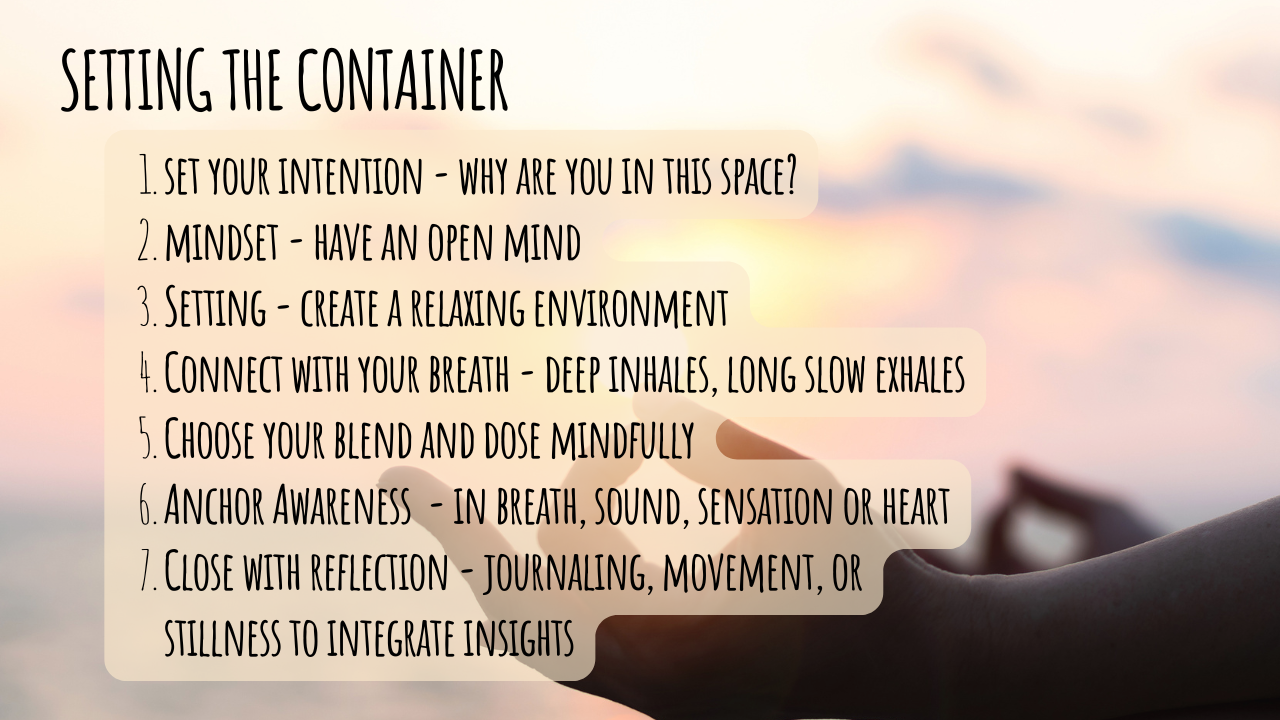
Setting the Container
Before any mindful or ceremonial practice, it’s essential to set the container—to create an intentional space that holds your experience with safety and reverence. The container is both inner and outer: the physical environment you’re in, and the energetic space you create through intention.
When we set the container, we signal to our body, mind, and spirit that we are crossing a threshold—from the ordinary into the sacred. This can be as simple as lighting a candle, smudging with an herb, playing gentle music, or silently stating your purpose for the meditation.
A clear container helps focus the energy, keeps you grounded when emotions or insights arise, and honors the plants as conscious allies on your journey.
Many people say that they can’t meditate because their minds are too busy or the pain in their bodies is too distracting to sit still. Cannabis can soften this resistance and help people experience moments of genuine stillness early on, building confidence in their practice.
1. Set an Intention
Intention acts like a compass, guiding your experience. Because Cannabis tends to amplify whatever is already present, setting a clear intention helps direct the experience toward mindfulness rather than distraction. This intention acts as a mental focal point. You can set intentions to calm anxiety, open your heart to connection, process difficult emotions, or even to connect with your inner wisdom. A clearly defined intention will help you navigate your experience.
2. Mindset
Having an open and accepting mindset for whatever arises is crucial. Sometimes emotions that have been buried surface during this practice. Approaching the experience with openness and respect, rather than as a means of escapism, will allow for non-judgmental awareness. You become the observer of your emotions without getting caught up in the story. This becomes a powerful tool for self-inquiry and healing. Be kind to yourself. And as always, if you are not feeling safe to handle intense emotions, consider reaching out to a therapist or trusted friend for support.
3. Environment
Your environment plays a significant role in facilitating a mindful experience. Creating a space that helps you feel safe and supported allows your nervous system to settle. This can be as simple as dimming the lights, lighting a candle, or connecting with the Earth—or as intentional as setting an altar, playing soothing music, and opening with a short ceremony. The container you build is not just physical—it is also about being around people who make you feel safe and at ease.
4. Breath
Once you have created your sacred space with intention and mindfulness, it’s time to connect with your breath. Bring awareness to the breath. Is it shallow or deep? Quick or slow? Where in your body do you feel it most prominently? Are you breathing through your nose or your mouth? Observe without judgment. Now, slow things down… take a deep inhale, feeling your belly expand as you count to four. Then slowly exhale for a count of six, letting your belly sink into your spine and empty completely. Hold on the exhale for two counts. Continue this pattern, allowing thoughts to drift by like clouds while gently refocusing on the rhythm of your breath.
5. Choose Your Dose
When using Cannabis mindfully, less is often more. Always start low and go slow (increasing your dose). Paying close attention to your body’s responses. While THC can increase your awareness, it's important to know your own limits. Going beyond what you are used to might lead to feelings of anxiety, nausea, or sedation. This threshold can vary significantly based on individual sensitivity, tolerance levels, and the overall composition of the Cannabis. Explore different chemovars (strains) rich in terpenes like limonene, linalool or pinene, which can support focus, uplift mood, or calm the nervous system, respectively. You can consume Cannabis in various forms, such as edibles, smoked flower, dry herb vaporizers, or even concentrate vaporizers. Personally, I find that concentrate vaporizers, due to their intensity and rapid onset, can sometimes be less conducive to cultivating a gentle, mindful awareness. However, this is a personal preference, and others may find them suitable. Some people may find that CBG or THCA can bring a clear-headed presence, while CBN may support deep relaxation. Experiment to see what works best for you.
6. Anchor Awareness
The breath is always happening in the present moment, so this is a great place to focus your attention, anchoring your awareness there. This becomes a focal point that you can return to when your mind begins to wander. It is entirely normal for the mind to wander during meditation; the practice lies in acknowledging the thought or distraction without judgment and then returning to the breath, again and again. Cannabis can enhance this focus by heightening interoception—your awareness of internal body sensations. This heightened awareness can make traditional anchors like the breath, heartbeat, ambient sounds (singing bowls), or tactile sensations (mala or prayer beads) more vivid and easier to stay connected to.
7. Close with Reflection
After the meditation, consider integrating what you have witnessed and learned. Have a journal nearby to write or draw your experience. Sometimes creative ideas spring up from these quiet moments. But occasionally, deep emotions come to the surface. Make sure to talk with a trusted friend or healthcare provider to process your thoughts and feelings. Engage in some somatic movement, such as gentle stretching or yoga, to help release any surfaced emotions. You may find that, through these intentional settings, you can move more easily through these emotions. Integration is about applying what you've learned to your life and recognizing the patterns that influence your behaviors. It’s in this process that the potential for lasting, meaningful transformation truly resides.
The Science Behind the Stillness
Cannabis may help the brain transition from busy beta waves (associated with thinking, planning) into alpha waves (linked to relaxed focus) and theta wave states (associated with deep meditation), states that experienced meditators often access naturally. For those who suffer PTSD, anxiety, depression, pain, or overstimulation, accessing these states naturally can be difficult. Cannabis may provide a sense of ease, making mindfulness more approachable.
This is the Endocannabinoid System (ECS) at work. The ECS is a system responsible for maintaining balance across various bodily functions, which can help us feel better, safer, and more at ease. Cannabis, when approached with intention, may act as a bridge between the busy mind and a quiet heart. From a physiological perspective, it interacts with our Endocannabinoid System, potentially helping shift the nervous system from a stress response (sympathetic) to a rest-and-digest state (parasympathetic). From a holistic perspective, it may open our senses and heighten awareness of both inner and outer landscapes.
A Sacred Connection
Many practitioners report a sense of communion with nature, their higher selves, or even with the spirit of the Cannabis plant itself. In my research and personal experience, by exploring Indigenous traditions from the First Nations peoples of Treaty 3, as well as ancient traditions, I have found that many cultures use plant allies ceremonially to open spiritual vision. I approach this topic with deep respect and humility.
When Cannabis is approached with intention, it transcends casual consumption and becomes ceremonial. Ceremony can elevate the experience—it's simply about setting an intention. Whether it's as easy as lighting a candle or as elaborate as creating a sacred space with your cherished objects, make it authentic to you.
This shift in mindset turns a typical session into a sacred practice.
Meditating with Cannabis isn’t about escaping - it’s about arriving. Arriving fully in the now. Arriving in our bodies. Arriving in relationships with the living world. As you cultivate presence and self-awareness, may you also cultivate compassion for yourself and all beings. May this practice be a path to greater peace and understanding.
Cannabis and meditation are not about escaping life. They are about learning how to arrive more fully in it. When we slow down, breathe, and listen, the plant becomes a companion rather than a crutch, and meditation becomes a conversation rather than a task.
If you feel called to explore this relationship in a gentle, guided way, you’re invited to join CannaSoul Connection — a monthly ceremonial space where cannabis, breath, and presence come together to deepen your connection to body, heart, and inner wisdom.

Published in the Effective Cannabis Newsletter November 2025.
A medical cannabis newsletter for patients and doctors.